
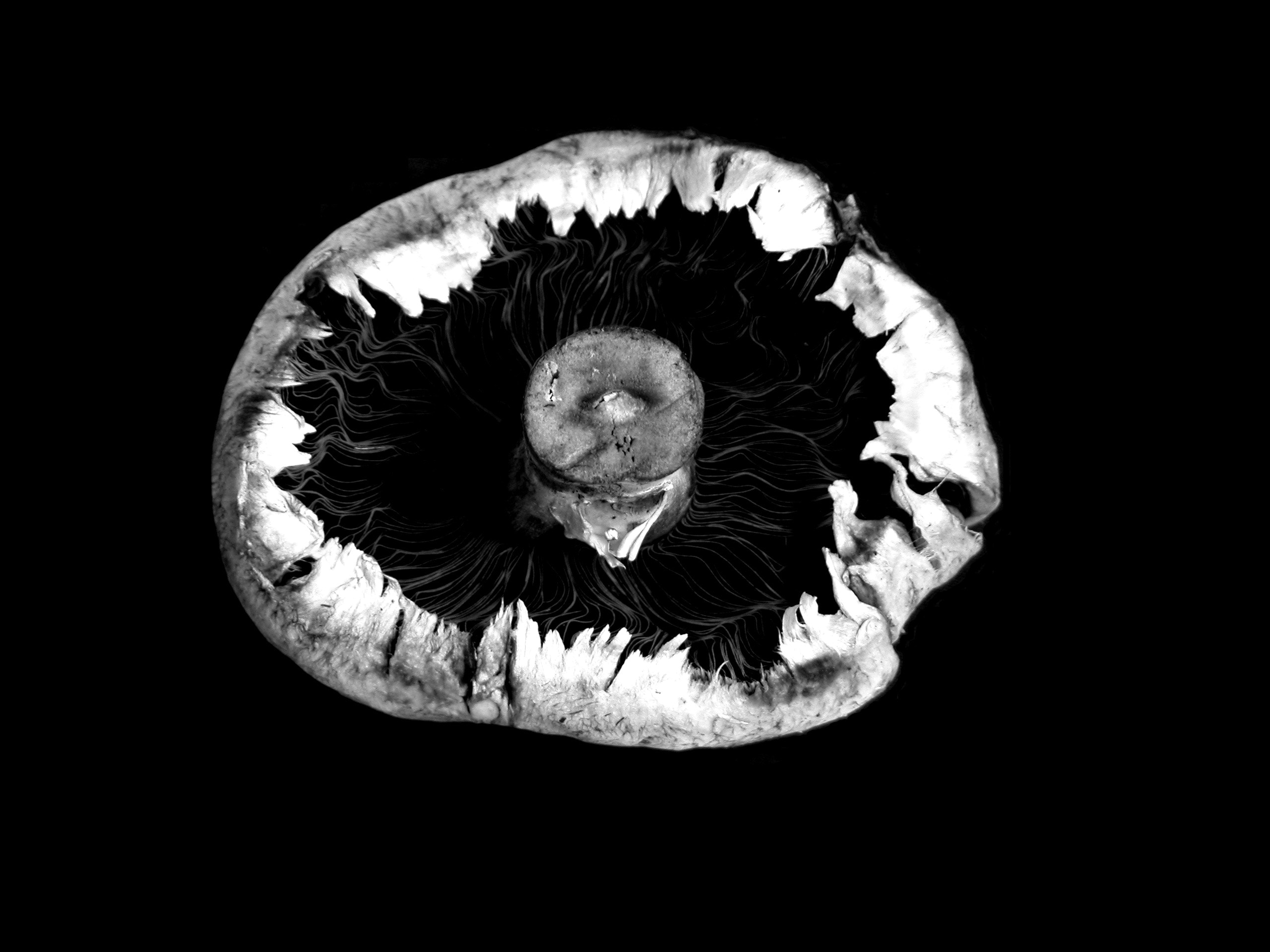
Mushroom by Matt Artz (Not P. cubensis)
Our bodies, like all living organisms, require proteins known as enzymes to carry out necessary chemical changes in our cells. In short, they carry out vital tasks such as producing ATP which living cells require to continue to live and thrive. Some enzymes can also be used to produce protective layers or deterrents as is the case in the fungus Psilocybe cubensis. This mushroom contains enzymes which produce a natural psychoactive drug Psilocybin, named after its producer. While the process to produce such a chemical undergoes known steps, the enzymes used in each organism can vary. Some may be more effective than others while some can use different initial chemicals. Psilocybin has been reconsidered for its psychological benefits and as such its synthesis has gained the scientific support to elucidate it.
In particular, the chemical is produced via a step known as decarboxylation in which a molecule of carbon dioxide is released. This particular enzyme catalyzed step uses amino acids with a chemical ring giving it the name of aromatic. For these reasons it is classified as an aromatic amino acid decarboxylase (AAAD) enzyme. While more steps are required to take the common amino acid tryptophan for example and convert it into psilocybin, it is an important first step which remains to be elucidated. As Torrens-Spence and colleagues mention, the same type of decarboxylase enzyme has been studied in different animals and plants but remain to be studied as thoroughly in fungi. The Psilocybe enzyme seems to vary from typical enzymes of the same type and as such is referenced as a “non canonical” variant (referred to hereafter as PcncAAAD).
Torrens-Spence et. Al. set out to better understand this enzyme PcncAAAD through structural imaging and composition comparisons. They compare the different segments of the structure in the genes and the amino acids which make up the enzyme respectively. The group also places the gene for the protein into yeast and performs experiments to understand it activity. They find that PcncAAAD can use the amino acids tryptophan and phenylalanine but seems to function more efficiently and easily with phenylalanine. Most of the structure of the enzyme was imaged by x-ray crystallography which is a process by which the molecule is crystallized and then x-ray beams are fired through them. The pattern formed by passing through is observed and used to make the original predicted image.
Through this set of data they are able to uncover the specifics of the enzymes catalytic activity. They find that there are a few metal ion binding sites and which amino acids are involved. In particular they find that calcium can bind with the enzyme to change the shape which allows to make modular changes to the enzyme’s activity. This coupled with more description of the active site which carries out the enzymes activities allows scientists to better understand and therefore optimize and use the enzyme outside of its original purpose. As such the last figure where they describe performance under different temperatures and ion conditions provides yet another scale upon which to gauge where to best work the enzyme.
While at first glance it may seem that this knowledge is incredibly niche, many of our discoveries begin as esoteric escapades to the public. Knowledge for knowledge sake allows discoveries of potentially beneficial discoveries. Thanks to Torrens-Spence and colleagues scientists can better manipulate the enzyme in question. This way, should a new cellular process be revealed which involves it, it can be explained properly and the discussion can progress. Even in a simpler case where the enzyme performs a redundant process, a new enzyme has been added to the repertoire of known potentially useful molecules.
In Depth
The research group did a good job of honing in on how this enzyme is composed and functions. Their methods are detailed and clear for the most part and their reasons are laid out in the previous portions of the paper. The formatting of the sections such as introduction and results is done in a way which is personally really appreciated. They do however face issues and seem to continue on without addressing either the need to cover that topic as is the case with the x-ray crystallography of the homodimer of PcncAAAD. They mention that a particular lysine loop involved in the homodimer formation could not be observed properly but do not further lead this to be corrected or for other labs to progress with. The images generated however do a phenomenal job of conveying the structure and layout of the molecule in a way expected of review articles after preparation and studies have long since concluded. The potential applications of this extend beyond the direct use in psilocybin production
Torrens-Spence, M. P., Liu, C.-T., Pluskal, T., Chung, Y. K., & Weng, J.-K. (2018). Monoamine biosynthesis via a noncanonical calcium-activatable aromatic amino acid decarboxylase in psilocybin mushroom. ACS Chemical Biology.doi:10.1021/acschembio.8b00821
Matt Artz. https://unsplash.com/@mattartz
Unsplash. http://unsplash.com
 The Lead
You must be logged in to post a comment.