
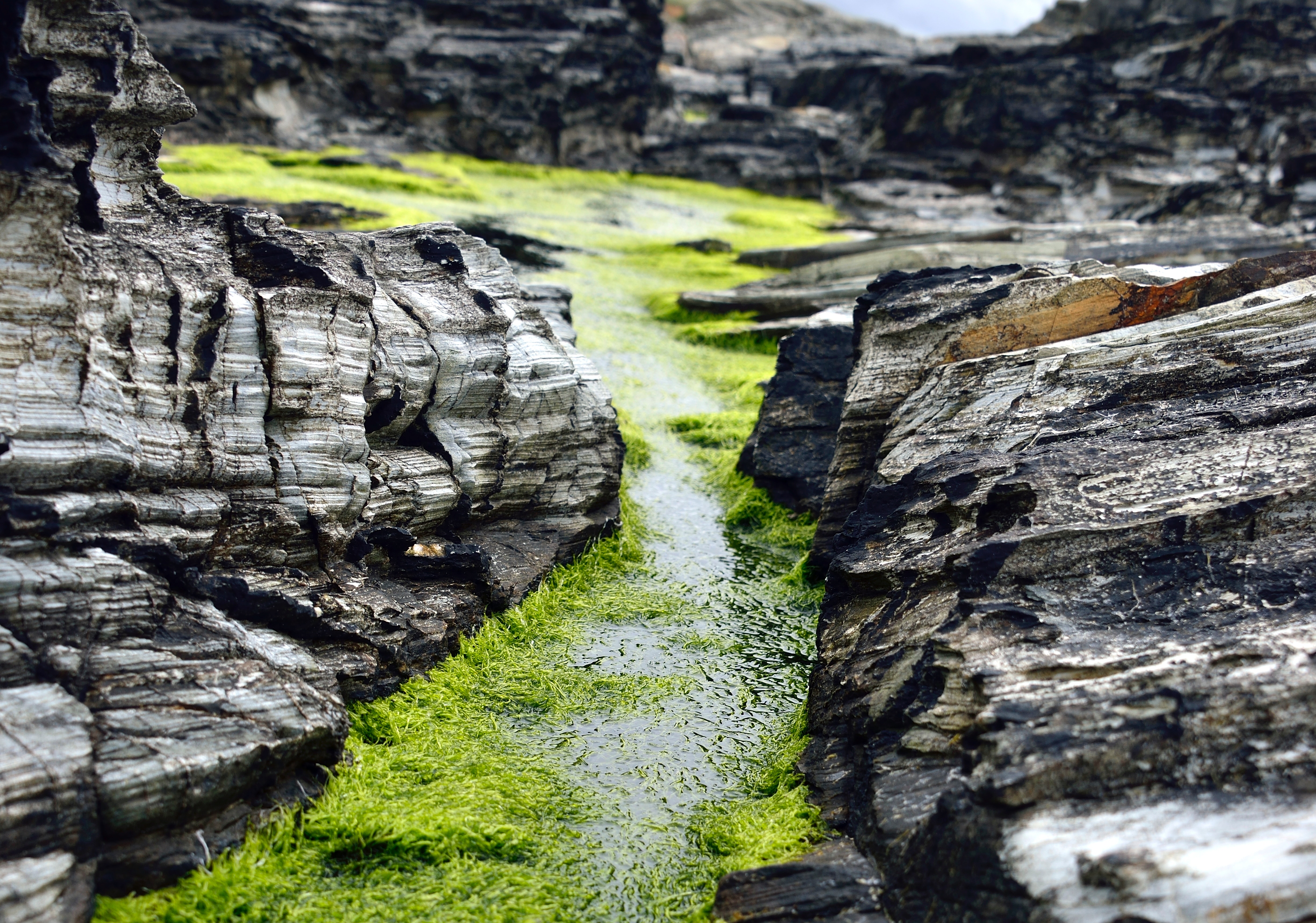
Outdoors and Algae by Vineet Nangia
Oxygen comes from land plants like trees and shrubs but aquatic organisms like phytoplankton and algae. Despite generating a majority of new chemical energy for organisms across the globe through the crucial process known as photosynthesis, it is not entirely understood. To find all the pieces involved in photosynthesis a lot of genetic analysis needs to be done to really understand the process. Many proteins involved in the process have yet to be researched let alone identified and linked to corresponding genes. Chlamydomonas reinhardtii is a facultative chemoautotroph which means it is able to use photosynthesis to produce its own food source when light is present or other sources when it is not. It is also a carrier of conserved ancestral genes and can grow as a haploid which is only a half-step of sexual reproduction. Due to these reasons C. reinhardtii is a good subject in which to study photosynthetic genes and proteins.
Li and their team set out for the big task of taking the first step in the entirety of this research progress. Using C. reinhardtii they generated a barcoded library of mutant genomes where different genes were inactivated by a process known as insertional mutagenesis. Essentially this refers to the fact that they inserted known segments of DNA into the organism’s DNA in different gene segments which allowed them to not work properly or not be expressed. In this case they used DNA segments with two barcode sequences to identify them later and a gene for paromycin resistance. The resistance gene was used to kill off any cells which did not take in the sequence and barcodes. This eliminated any properly mutated genomes from their library as they continued to grow those which survived the insertinal mutation. This created the barcoded library of around 62,000 mutants which potentially provides a thorough scientific perspective on not just photosynthesis, but all implicated genes in C. reinhardtii which may allow it to serve as another model organism down the road.
Using these mutants, Li et. Al. find 303 genes associated with photosynthesis due to the fact that when they are messed with, the process is halted or diminished significantly. They can isolate these changed organisms by making use of the organisms ability to use acetate as a food source to survive when unable to use photosynthesis. 65 of those genes are involved with previously discovered proteins and as such were able to be linked with appropriate genes. Then some 15 genes are involved in regulation of transition period in the photosynthesis pathway. These findings in and of themselves are quite substantial and helpful in continuing the progress made in these areas. Yet they don’t stop here and instead proceed to analyze a gene and associated protein among the many they identify.
The study continues with one of the many protein coding genes and aims to help whittle down the enormous genetic data. Starting with CPL3, they identify it as a phosphatase whose role is removing phosphate groups from molecules in the cell. They find that when CPL3 is insertionally mutated, the algae are unable to have significant photosynthetic growth. This effect can be reversed by reinserting the healthy common or wildtype CPL3 gene in place of the affected one. The process can be recovered by the return of the gene suggesting it is in fact involved with a critical part of photosynthesis. They hypothesized that the phosphatase has effects in accumulation of protein complexes. They then show that in fact it allows thylakoid accumulation using a protein identification using antibodies in a process known as Western blotting as well as through whole cell proteomics, the process by which all actively produced cellular proteins are listed. Taking the extra steps to encourage further progress, Li et. Al. clarify the function of one of the many genes in C. reinhardtii as having a direct role in photosynthesis. Providing this information as well as the mutants generated allow scientific work to start and continue to grow which will further our understanding of a seemingly familiar cellular process.
In Depth
The study is conducted thoroughly with attention to evidence with conclusive findings. No significant stretched conclusions are evident in the paper and peripheral research is done to identify previously identified genes and proteins so that the linking of findings is facilitated. In particular, the work done to provide the mutant gene sets as well as the physical mutants to other labs is laudable and should become more common. The pursuit holds strong emphasis on gaining knowledge for knowledge’s sake and cooperation. Explanations on methods were significant and seem to provide adequate instructions so that it is reproducible. A better understanding of cellular processes such as photosynthesis can lead to new integrations in technology as well as genetic engineering. Understanding this light harvesting process in more detail can allow for better optimization of solar panels or enhancing plant and algal generation of bio fuel. Like many areas of research the application of the knowledge can produce equally important changes as gaining the knowledge simply for scientific advancement.
Li, X., Patena, W., Fauser, F., Jinkerson, R. E., Saroussi, S., Meyer, M. T., … & Vilarrasa-Blasi, J. (2019). A genome-wide algal mutant library and functional screen identifies genes required for eukaryotic photosynthesis. Nature genetics, 1.
Unsplash. http://www.unsplash.com/
Vineet Nangia. https://unsplash.com/@vineetnangia
 The Lead
You must be logged in to post a comment.