
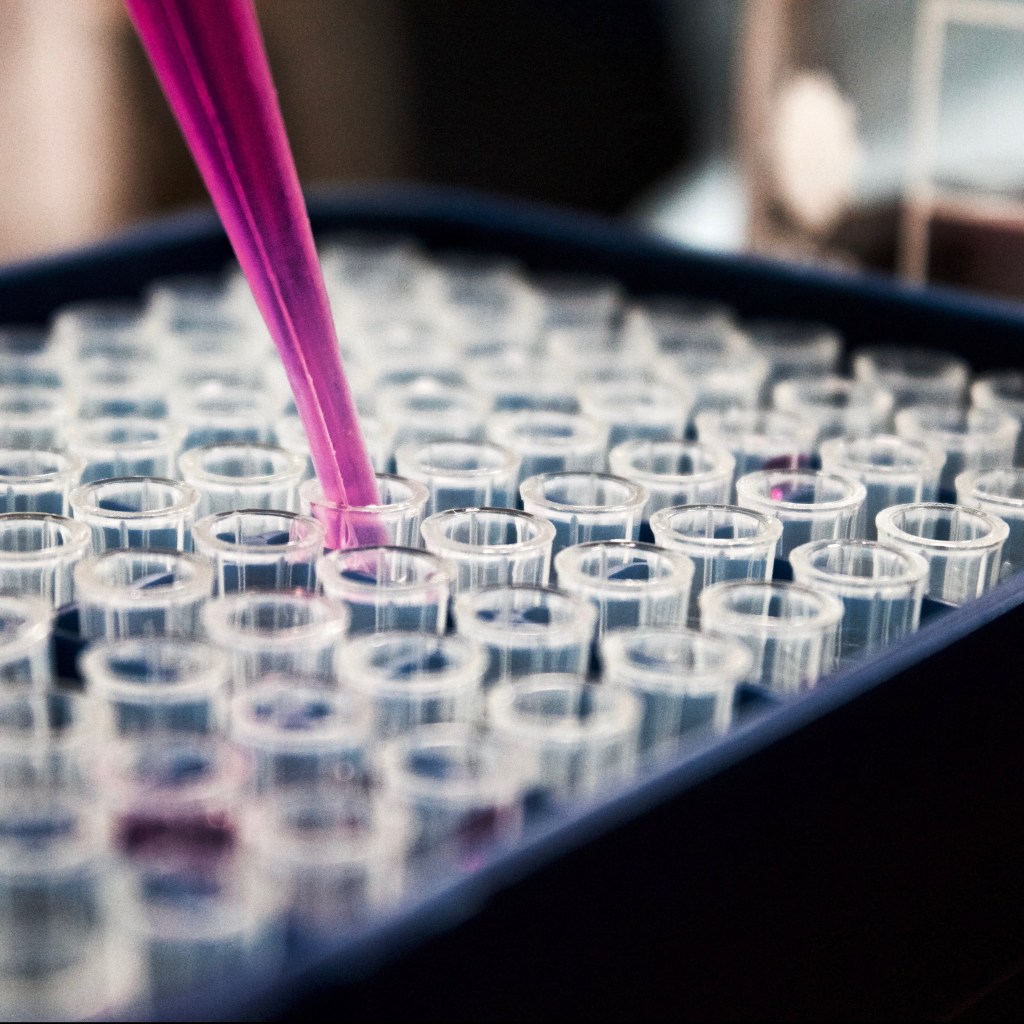
Purple Pipette by Louis Reed
CRISPR is one of the biggest scientific advancements in recent years due to the potential it represents. As a gene editing tool it stands to benefit science and technology from many different points. The acronym stands for clustered regularly interspaced short palendromic repeats which refers to how the enzyme system works. It works mainly through the use of small segments of genetic code that is repeated in clustered regions of DNA. CRISPR commonly refers to a system of protein enzymes which act as a bacterial and archael defense mechanism which serves a purpose similar to our own immune system. This enzyme system can be used to edit genes and therefore be applied as a tool to treat or manipulate different instructions found in our genetic code.
CRISPR was initially found in E. coli, our age old research subject, which was used to respond to viral attackers. When a bacterial host was attacked and survived, the bacteria took advantage of leftover viral DNA and saved it in its own DNA using special Cas proteins. The viral DNA is chopped up into small segments and stored as spacer sequences between the repeated sequences in the CRISPR set or array. The repeats are used as markers for larger Cas proteins to find the spacers The repeat and spacer sequences are combined into a guide DNA segment for the Cas protein to use when a virus attacks.
Cas9 is the most well known Cas protein due to the fact that it is one large independent molecule. In the cell, Cas9 is then able to compare guide DNA with other DNA to find the bad viral DNA and chop it up before and damage is done to the cell. In laboratories however, scientists discovered that this system can be hijacked to not only find bad DNA, but to cut out genomic DNA and edit the code to our very cells. This process was further understood and refined by researchers Jennifer Doudna and Emmanuelle Charpentier to use the simpler Cas9 system which only involved the large gene editing enzyme molecule.
Finally, enter Wright and colleagues whose research aims to study the more minute details of CRISPR systems. In their case, type V CRISPR systems use many orchestrated Cas proteins as a complex unlike type II Cas9 CRISPR. Type V CRISPR contains a number of different systems which all use different proteins to accomplish the main task of excising templates and cutting up harmful DNA. The difference is found in V-C and V-D CRISPR, a subset of CRISPR systems, which actually lack a common Cas2 protein in the acquisition step.
In their study, Wright et. Al. Show that these CRISPR systems actually lack the stabilizing protein Cas2. Instead Cas1 takes on the role of the typically coupled proteins. They show how Cas1 independentely forms a tetramer or complex of four copies and finds the prespacer sequence for safe storage. While this seems unimportant for CRISPR’s huge potential, it actually reveals some viable modular aspects of the gene editing tool.
First, it seems to be the first step in backtracking the evolution of the CRISPR defense mechanism. Much like primordial RNA enzymes, it seems smaller and independent complexes were responsible for a quick and hasty solution to the viral atracks. Second, finding existing modalities in the CRISPR tool will allow us to form systems for different purposes. As such enlightening the different components such as an independent Cas1 cab pave a way for simpler, precise, or effective editing.
In Depth
Experimental findings by Wright et. Al. elucidate a modular aspect of a CRISPR system which could help improve its functionality. This could be by making systems more or less similar to those that work better or worse respectively to what is necessary. Their conducted experiments do however seem bolstered where they require a radioactive detection method. Pure detection of open ring plasmid spacer hybrids revealed low quantities in their experiments and so they simply move to a more sensitive radio tag detection method. This could be either due to poor methods or simply a desire for better results but it wasn’t addressed to the readers explicitly. They do however do a good job of depicting the segments as spacer and repeat sequences alongside the leader sequence and showing the fourth degree confirmation of the Cas1 proteins. Overall the experiments conducted were invaluable to the future capacities of the CRISPR editing systems to be and the data provided will help create those optimized systems.
Addison V. Wright, Joy Y. Wang, David Burstein, Lucas B. Harrington, David Paez-Espino, Nikos C. Kyrpides, Anthony T. Iavarone, Jillian F. Banfield, Jennifer A. Doudna. A Functional Mini-Integrase in a Two-Protein-type V-C CRISPR System. Molecular Cell, 2019 ISSN 1097-2765,
https://doi.org/10.1016/j.molcel.2018.12.015.
Bozeman Science. What is CRISPR? Review. https://www.youtube.com/watch?v=MnYppmstxIs
Louis Reed. https://unsplash.com/@_louisreed
Researcher App. https://www.researcher-app.com/
Unsplash. Researcher App. https://www.researcher-app.com/


You must be logged in to post a comment.